Home The Future of Greenfield Development: Balancing Feasibility, Growth and Innovation

The Future of Greenfield Development: Balancing Feasibility, Growth and Innovation

Author: APAA

15 October 2026

Executive Summary

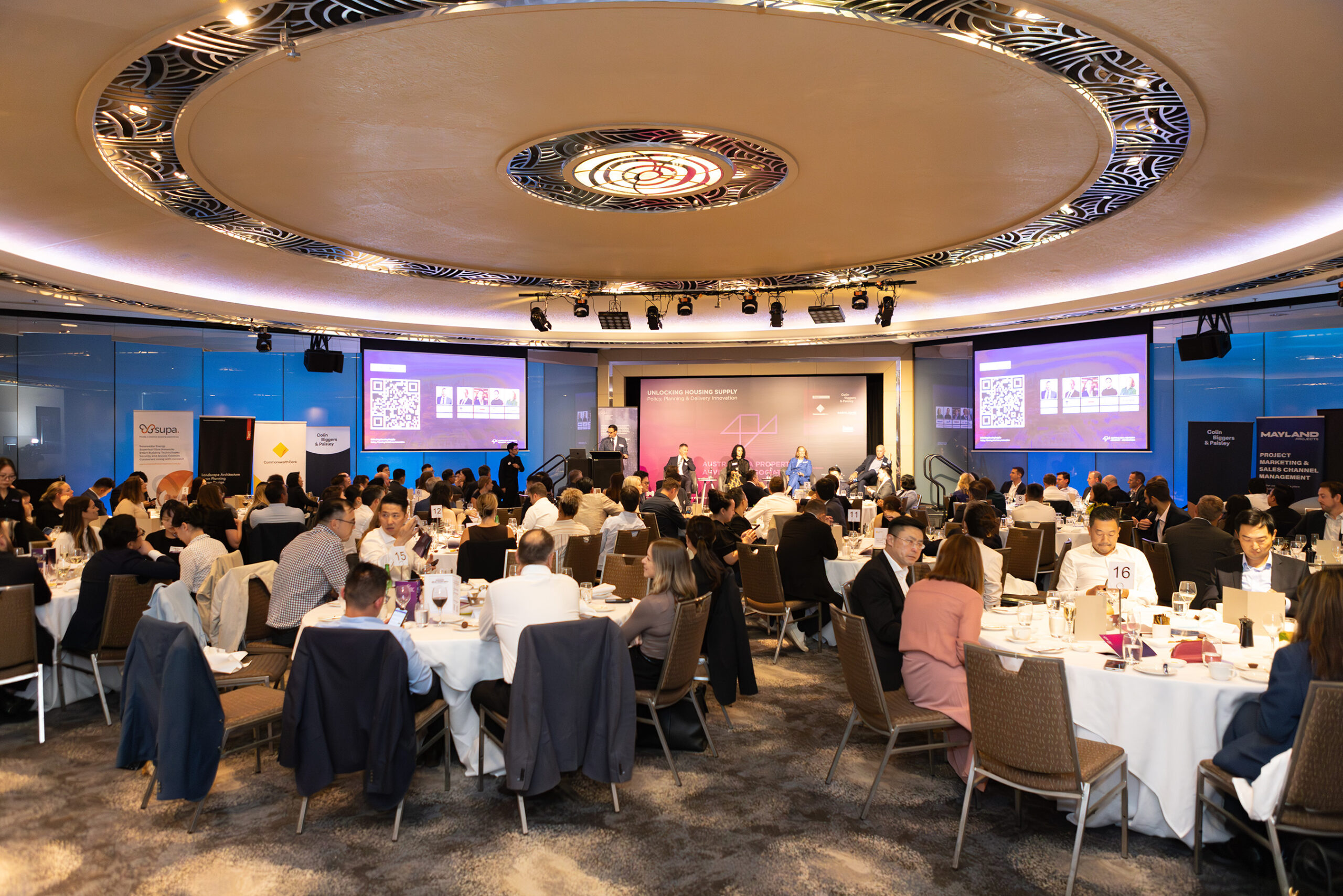
APAA’s 2026 Greenfield Forum asked a simple but pressing question: why is Victoria’s significant land and housing capacity not being turned into new homes at the scale and pace needed? The discussion drew together market confidence, global economic conditions, project feasibility, infrastructure, approval pathways and innovation.

David Southwick MP, Victoria’s Shadow Minister for Planning, Housing & Building, and Tourism & Major Events, identified confidence and certainty as essential conditions for investment. He argued that housing policy should support choice across greenfield, infill and other housing types. He also pointed to the time and cost involved in bringing growth-area projects to market, and called for better coordination between approval authorities, infrastructure delivery and industry investment.

James McIntyre, Australia and New Zealand Economist at Bloomberg Economics, placed Victoria’s development market within a global repricing of capital. Higher bond yields, energy and geopolitical pressures, large-scale investment in AI and renewables, and competition for skilled trades are all pushing up development costs and weighing on feasibility. His analysis of the housing market highlighted weak approval numbers in Victoria and a market that appears undervalued but is waiting for greater confidence before it moves.

Shaun Eisel, Principal Engineer and Victorian Lead at Inertia, looked at feasibility at the project level. Comparing Victoria with South East Queensland, he showed how achieving engineering certainty earlier, supported by digital tools, can reduce time, cost and rework, making project delivery more efficient at a time when feasibility is under pressure.

The central question: How can greenfield development become more feasible, certain and productive without compromising quality?

1: The Greenfield Development Challenge

Greenfield development depends on much more than the availability of land or planning capacity. A project’s ability to proceed comes down to how a range of factors work together such as land cost, finance, infrastructure, servicing, construction capacity, approval timeframes, government policy and market demand.

There remains a gap between what could be built in theory and the housing that can be delivered. Land may be identified for growth and capable of development on paper but turning that potential into homes requires projects that are financially viable, serviced, approved, buildable and backed by both authorities and the market.

Greenfield development today requires a whole-of-system delivery response. Better outcomes will require greater certainty and coordination across planning, infrastructure, engineering, government, industry and the market, together with new approaches to how projects are assessed and delivered.

2: Confidence, Housing Choice and Enabling Growth

In his opening address, David Southwick MP, Shadow Minister for Planning, Housing & Building, and Tourism & Major Events, described confidence and certainty as the foundations of investment and housing delivery. He argued that the government’s role is to let the market respond to demand across a range of housing types and locations, including greenfield growth areas. He also pointed to the growing time it takes to move growth-area projects through to delivery, and the extra cost and risk that these delays create.

Mr Southwick also outlined possible changes to land tax and other property taxes, along with broader government spending priorities. He presented these as ways to improve investment conditions, confidence and affordability.

A theme that ran through the evening was that infrastructure must be planned and delivered alongside growth, not after it. Delivering water, transport and community infrastructure earlier avoids costly retrofitting. Closer coordination between authorities and industry also gives developers clearer signals about when projects can proceed.

3: Global Economic Conditions and the Cost of Development

James McIntyre, Australia and New Zealand Economist at Bloomberg Economics, set out the global forces shaping Victorian development and what they mean for the cost of capital, construction and housing demand.

A global repricing of capital. Long-term government bond yields have risen across major economies, which Bloomberg described as “bond market revenge”. Higher risk-free rates feed into borrowing costs and investment decisions across the economy. Victorian development conditions therefore cannot be separated from global financial markets. This is sharpened locally because Victoria’s borrowing costs carry a larger margin over Commonwealth bonds than those of NSW or Queensland, which limits the state’s capacity to fund infrastructure.

Energy and geopolitical pressures. Conflict-driven increases in oil, petrol and diesel prices flow directly into construction, transport and earthworks costs. Wider disruption to commodities and supply chains adds further uncertainty. Rising defence spending around the world adds another source of demand for capital and resources.

Competition for trades. A major investment cycle in artificial intelligence, data centres, renewable energy and electricity networks is driving intense competition for capital, construction capacity and skilled trades, especially electricians. That competition flows through to the cost and availability of the resources needed for housing and infrastructure.

A Victorian market waiting for confidence. Total Victorian dwelling approvals remain weak. In real terms, Melbourne is now “generationally cheap” compared with Sydney and Queensland, giving Victoria a strong affordability base for future demand. However, low turnover shows that buyers, sellers and investors are still holding back. This matters because greenfield feasibility ultimately depends on achievable sale prices and how quickly the market absorbs new stock.

4: Feasibility, Due Diligence and Innovation

Against this backdrop, Shaun Eisel, Principal Engineer and Victorian Lead at Inertia, focused on why early, reliable feasibility testing has become increasingly critical. His core point was that the earlier a project can test its engineering, grading, lot layout and cost assumptions, the more opportunity there is to identify risks, compare options and make informed decisions before detailed design and construction.

Victoria and Southeast Queensland provided the context for this challenge.
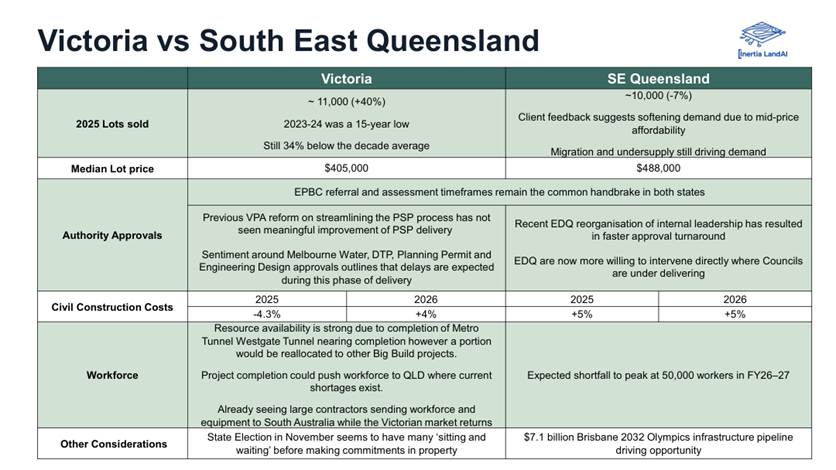
Figure 4

Figure 4. Victoria versus South East Queensland. Source: Inertia LandAI presentation.

This comparison reinforces that market demand alone does not determine delivery. Where approvals, infrastructure or engineering take a long time, uncertainty can carry through acquisition and master planning. Bringing better engineering information forward reduces that uncertainty and lets project teams make or change decisions while they still have flexibility. Doing this quickly also makes a project more resilient to shifts in the market.

This is where the time, cost and quality relationship becomes important. Conventional approaches can require significant time to test grading and earthworks options, creating pressure to settle on a design before all alternatives have been explored. The proposition behind Inertia’s LandAI is different. In harnessing this innovative approach to engineering design, it allows an increasing number of calculations to be undertaken in a short period, so that more development options can be tested early.
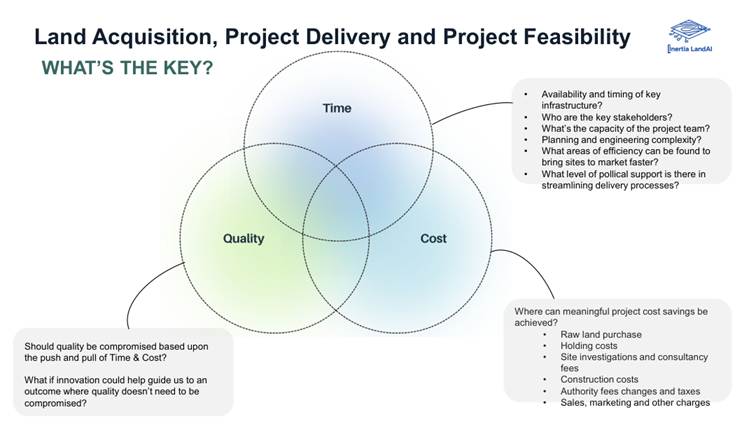
Figure 5

Figure 5. Land acquisition, project delivery and project feasibility: time, cost and quality. Source: Inertia LandAI presentation.

Three projects showed the results:

  • South Australia (land lease community, ~250 lots): about 10 weeks and $500,000 in construction costs saved, with a fully tested design that allowed the project to proceed with confidence.
  • Victoria (masterplanned community, ~1,000 lots): about $1.5 million saved on earthworks export, with better lot presentation and lower site preparation costs for home builders.
  • Queensland (masterplanned community, ~7,000 lots): about 26 weeks saved and over 2.5 million cubic metres less export (around $30 million), with multiple scenarios tested to find the highest-value outcome.

The broader significance is the ability to move with certainty through the project lifecycle.’s LandAI is an advanced technology that can be used to amplify civil engineering expertise and facilitate earlier decision-making for the delivery of better developments.

Importantly, the technology was not presented as a replacement for professional expertise. Engineering judgement, collaboration and human decision-making remain central to delivering liveable and commercially viable communities.
5: From Approval Pathways to Development Productivity

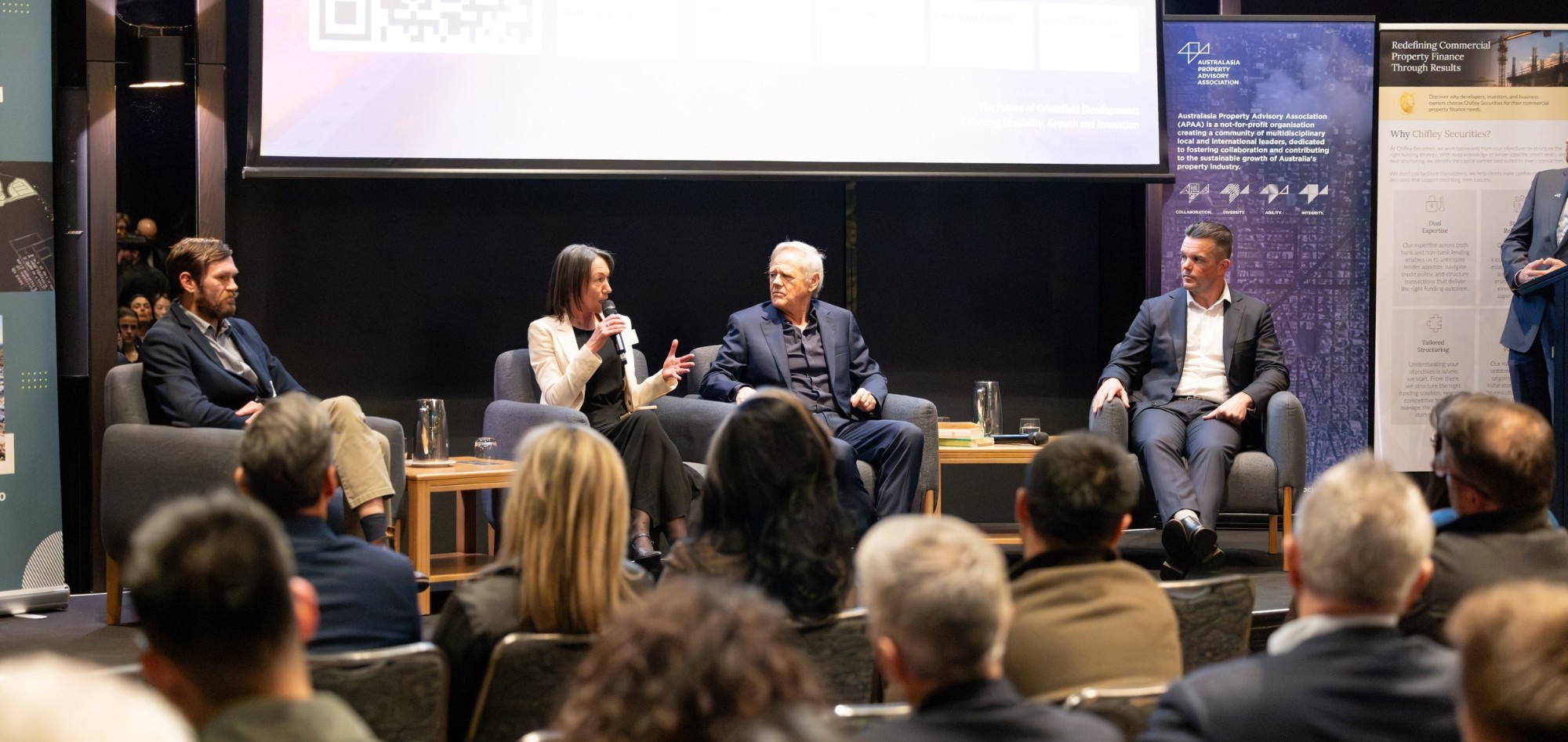
The panel discussion, moderated by Anthony Jansen of the APAA Executive Committee, focused on improving the system as a whole rather than fixing any single step. Panellists agreed that better coordination, clearer responsibilities, earlier information and closer collaboration across planning, engineering, infrastructure, finance and construction can give greater confidence to development outcomes without sacrificing quality.

Panellists saw technology and professional accountability as working hand in hand. Technology can handle repeatable technical compliance, freeing up time for matters that need professional judgement. Some panellists suggested that, while government reviews continue, more reliance could be placed on accredited professionals with clear accountability after planning approval.

Penelope Forrest, General Manager at AVID Property Group, stressed the importance of clear pathways and institutional capacity. She pointed to South Australia as a smaller and potentially more nimble delivery environment. She also noted that masterplanned communities can build in community infrastructure, climate resilience, tree canopy and housing diversity from day one, complementing appropriate density in established areas.

Mike Day, APAA Advisory Board Member and Co-founder of Sharp | Day, linked delivery efficiency to place quality. Using Ellenbrook in Western Australia as an example, he showed how early collaboration between government, builders and housing providers can deliver diverse housing, integrated community outcomes and strong placemaking.

Liam Wilkinson, Manager, Strategic Futures at the City of Whittlesea, described Council’s facilitative approach: working closely with developers to resolve issues early, simplifying internal processes and giving clearer guidance on Council requirements. He also called for councils and industry to speak with a shared voice on critical growth-area infrastructure, especially public transport and roads.

Shaun Eisel reinforced that earlier engineering certainty gives every party in the approval chain better information to work with.

The panel acknowledged that infrastructure has not always kept pace with population growth. Infrastructure needs to be committed and delivered in a timely, coordinated sequence, and clear planning responsibilities are essential to maintaining certainty during periods of reform.

6: The Conditions for Deliverable Greenfield Growth

Five connected conditions emerged as critical to turning Victorian greenfield capacity into housing:

  • Feasibility is the central constraint. Land, holding costs, construction, finance, taxes, servicing and market absorption together decide whether approved land is developed.
  • Infrastructure must be sequenced with development. Transport, schools, water and other services determine whether growth areas proceed efficiently and function as communities from the start.
  • Innovation improves outcomes, not just costs. Testing more options earlier, under professional review, leads to better outcomes as well as savings in time and cost delivering necessary efficiency gains.
  • Confidence comes from clarity. Clear rules, defined responsibilities, predictable approvals and credible infrastructure commitments reduce uncertainty for public and private decision-makers alike.
  • Capacity is not the same as supply. Victoria has the land, the demand and the opportunity. Converting these into the right housing needs feasible projects, coordinated infrastructure, responsive approvals, authority support and enough construction capacity.

7: What Needs to Happen Next

Discussion across the forum pointed to a practical agenda built on feasibility, certainty, coordination and innovation:

  • Bring feasibility into planning and policy discussions earlier. Factor finance, construction, servicing, infrastructure and market conditions into planning and policy decisions from the outset.
  • Cut avoidable delays. Clarify responsibilities, improve infrastructure sequencing and strengthen coordination across agencies.
  • Use AI-enabled tools to test options earlier, guided by professional review, accountability and design judgement.
  • Project vision aligned to market demands, by maintaining diversity, placemaking and liveability while reducing unnecessary cost, rework and delay.
  • Strengthening collaboration between developers, builders, consultants, councils and government so capacity becomes housing that serves every part of the market.

8: Conclusions: From Land Capacity to Deliverable Outcomes

APAA’s Greenfield Forum 2026 brought together economic, project-delivery and industry perspectives on the challenges facing greenfield development. One theme was consistent: Victoria has strong fundamentals, including relatively affordable land and housing, but land availability alone will not deliver homes.

Projects must be feasible, financeable, serviced, approved and delivered in time to meet demand. That requires greater certainty in planning and infrastructure, stronger collaboration between government and industry, and a more coordinated approach to delivery. Technology can lift productivity by bringing certainty forward and reducing time and cost, without compromising quality or placemaking.

Increasing housing supply is a whole-of-system challenge, and greenfield housing will continue to play a critical role. No single reform will close the gap. Progress depends on how well planning, infrastructure, investment, construction, technology and industry work together to turn planned capacity into homes on the ground.

Focusing on one part of the housing delivery system such as planning or policy position will not meet demand. We must simply and directly focus on the productive and efficient delivery of all types of housing if we are to meet the needs of Victorians.

EDITORIAL NOTE: This paper is based on the event presentations and panel discussions. Political positions and market assessments are attributed to the speakers rather than presented as APAA positions.

Join our newsletter

Stay connected to Australia’s property industry and APAA upcoming events


Your information is confidential. If you wish to raise a matter of concern or lodge further queries, please feel free to email us at info@apaassociation.com.au